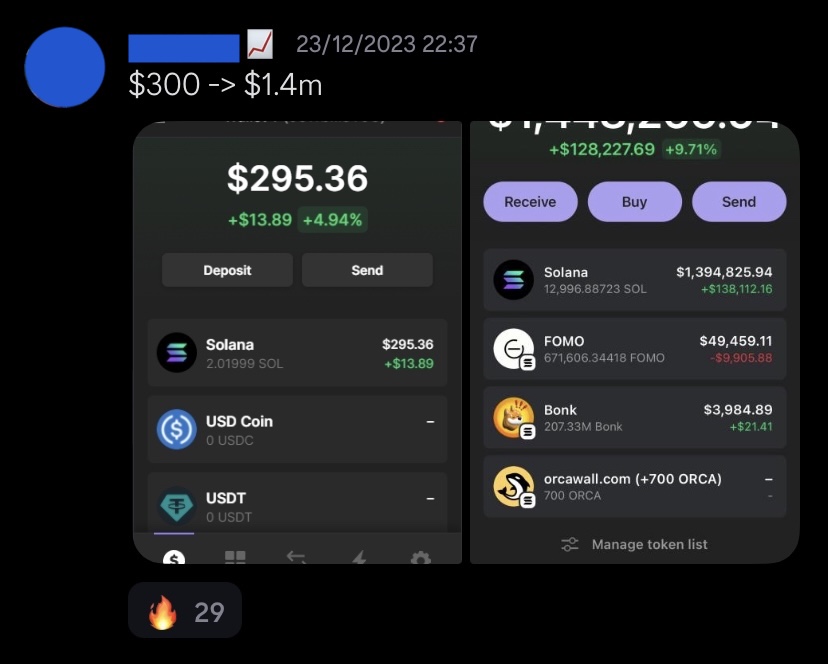
I first got into crypto in late 2023. While scrolling on X, I kept coming across a specific user that would post images of fat stacks of cash and bust down watches in front of a symbol of their crypto trading discord server. At the time I was early into running my E-commerce business, it was hard work, having to spend hours packaging and labelling thousands of units, from the minute i woke up to the minute i went to sleep i was working, it was grunt work. After seeing a post from that specific user on my feed once again, I decided to give it a try. While I wasn't interested in the bust down watches, I was in need of an easier source of money which I thought this Discord server could provide me with.
I joined the Discord server, loaded some money onto Coinbase, opened a ticket and paid $50 for a 1 week subscription. When I look back at this now, I wonder how I was so gullible, a post on X with someone flexing their watches and money saying "if you pay me $50 to join my Discord server, you will get rich too!" should raise every red flag possible. Surprisingly I didn't instantly get kicked and blocked after sending the money so now I was in. I spent some time observing the server before starting to trade, I was still unsure of how it worked or if they were going to scam me in another way.
The format of the Discord server was that there were "Callers" who were senior or proven members that would give advice or "signals" to purchase coins or to do specific things on chain. Compared to a lot of other similar servers, this one had a lot of "snipers" who would use highly specific setups of RPC nodes, sniping software and VPS in specific locations to be able to buy tokens on launch before anyone else to get a large portion of supply of the token at very low prices which not only gives them larger opportunities for profit but also control over the supply. A few of the snipers in this server became infamous in the Solana memecoin scene and some even ended up making generational wealth from it. I never got deep into sniping aspect of crypto, i tried out a few bots but i never had any luck. Its quite secretive as people who have a setup that works wouldn't freely give away info since you will end up being their competitor.
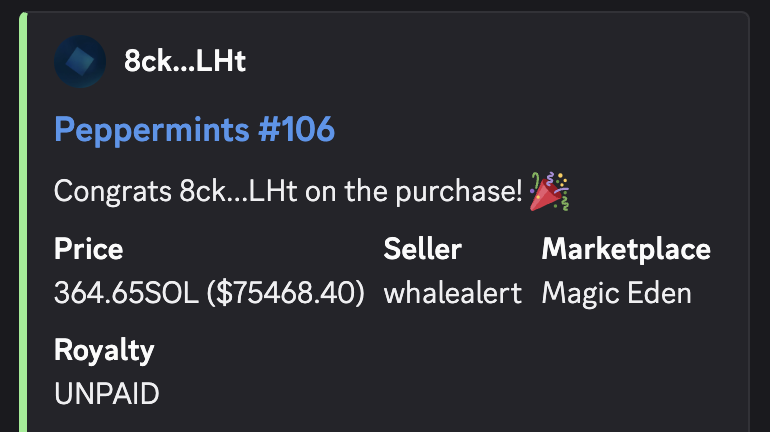
Like the majority of the people in the Discord server, I got deep into memecoin trading seeing it as a simple way to make quick money. Initially I would blindly follow the signals from the Discord and proceed to lose my money but the more I traded, the more feedback I received to fine tune my mental model. After depositing £100 to my Phantom wallet and proceeding to almost lose it all 5 times I finally started seeing patterns and opportunities. Low market cap coins are highly illiquid, when a holder wants to sell, if they are selling a decent amount, they can move the price of the coin by a significant amount. Whenever the price would jolt down after a single sell, usually people would quickly buy back in and the price would return to around what it was prior to the sell. This wasn't always the case, it mostly only occurred on slower moving coins that have been around for a few hours or sometimes it would just dip even further. But I saw this as an opportunity to make some money. Each dip could be about 5-15% so the profit opportunity in each trade most the time maxes out at about 15% ROI but doing them over and over again could add up. Me discovering this strategy wasn't a conscious thing like I explain it here, it was more just as I had more reinforcement learning, I eventually ended up here.
This method of trading was quite successful for me, at the lowest point my Solana wallet balance was at $38.75 but as time passed and i got better, that number slowly went up and up and in under 2 months, I went from $38 to $5050. While this isn't exactly life changing money, it gave me some trust and belief in the ability to make money in crypto. As time passed, I slowly kept growing my crypto net worth. There were many large down points and plateaus, but the general trend was going up.
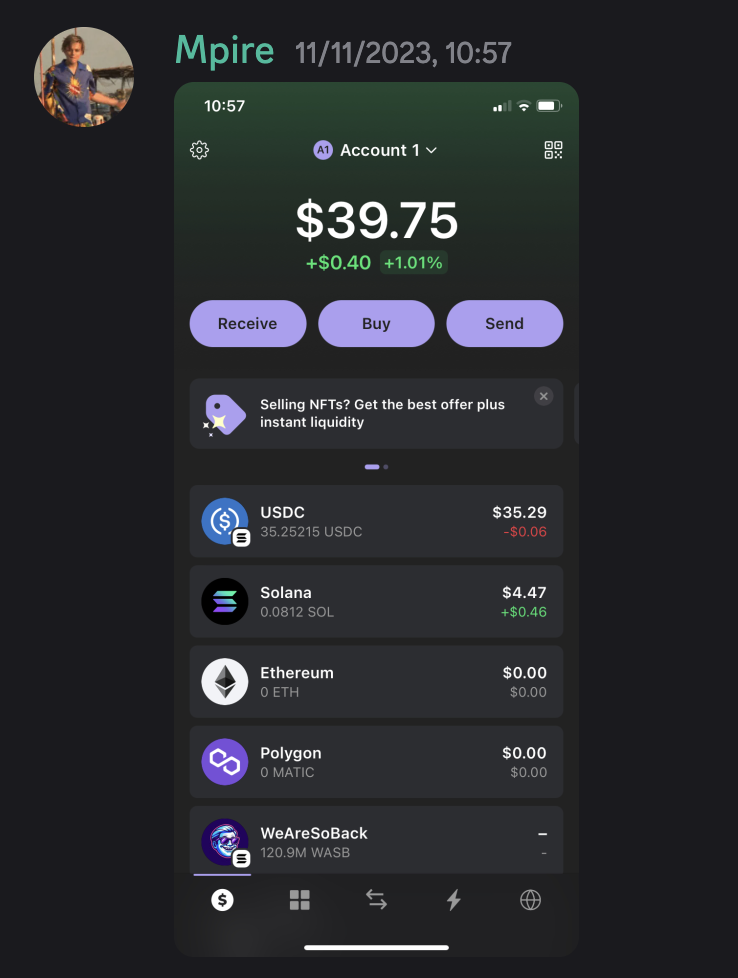
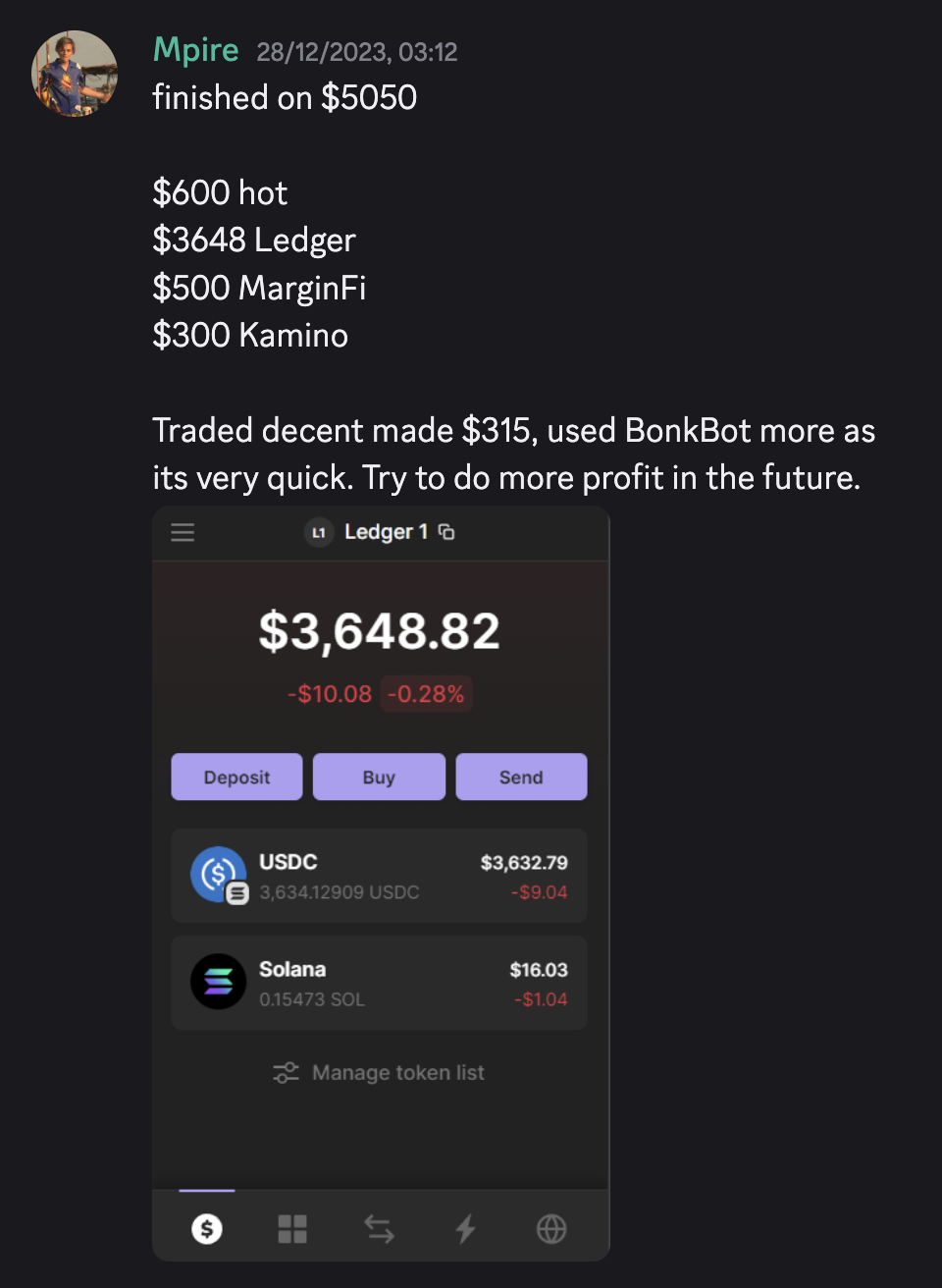
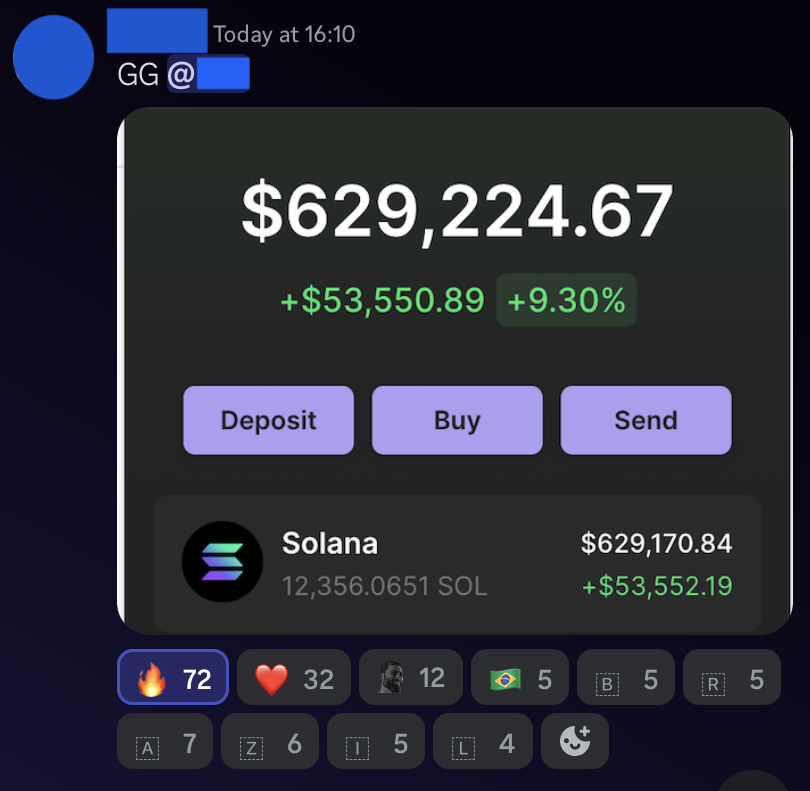
Being in the Discord server really helped my raise my standards of how well I could do and how big I was thinking. While at the time my e-commerce company was doing $4k profit per month after working most hours of the day doing back breaking work, in the Discord server, I could see people with a similar age and starting point as me start from nothing and go to profit numbers that don't even look real. When you're outside of crypto and you see crazy profit numbers from kids who should still be school, its easy to put it all on luck, and while chance does play a role, the dedication and skills that the top players have is undeniable. When the "lucky" people keep getting lucky, eventually you realise it wasn't even luck to begin with.
Discovering the farm
Apart from the sniping and general memecoin trading, another thing talked about in the server were airdrops. Generally, airdrops are rewards sent to users of a DeFi platform usually sent in the format of the platforms own token. The amount of rewards given to each user would usually depend on the amount or quality of interaction a user has done on the platform. DeFi platforms tend to do airdrops to try to get more users to the platform, to help it get more awareness or just to reward loyal users. These platforms won't always announce an airdrop but can sometimes hint to one by adding a points system to the app, talking about it for future plans or just not talk about it at all and keep it a secret until it happens.
DeFi platforms intend to reward real users of their app however there are ways you can game the system. Farming an airdrop is the idea of purposefully doing actions on a DeFi platform with the hopes of getting a future airdrop. One airdrop that was spoken about in the Discord group was for a decentralised exchange (DEX) called Jupiter. At the time I believe the Jupiter team was hinting at releasing a token and doing an airdrop so some people started farming it. To farm the airdrop they would just do lots of volume on the Jupiter DEX in the hopes that it would qualify them for the airdrop. When it came to December 2023 – January 2024, the Jupiter team became more clear about the Airdrop and started doing test launches of the coin.
I mostly traded using Raydium back then instead of Jupiter so my Jupiter volume was quite low but as I became more aware of the incoming airdrop, I started manually farming, just doing lots of random volume on a bunch of my wallets (little did i know it was too late for the upcoming airdrop as the volume cutoff to qualify you was in Nov 2023). Then, on January 31st 2024 known as "Jupuary" they distributed the first airdrop.
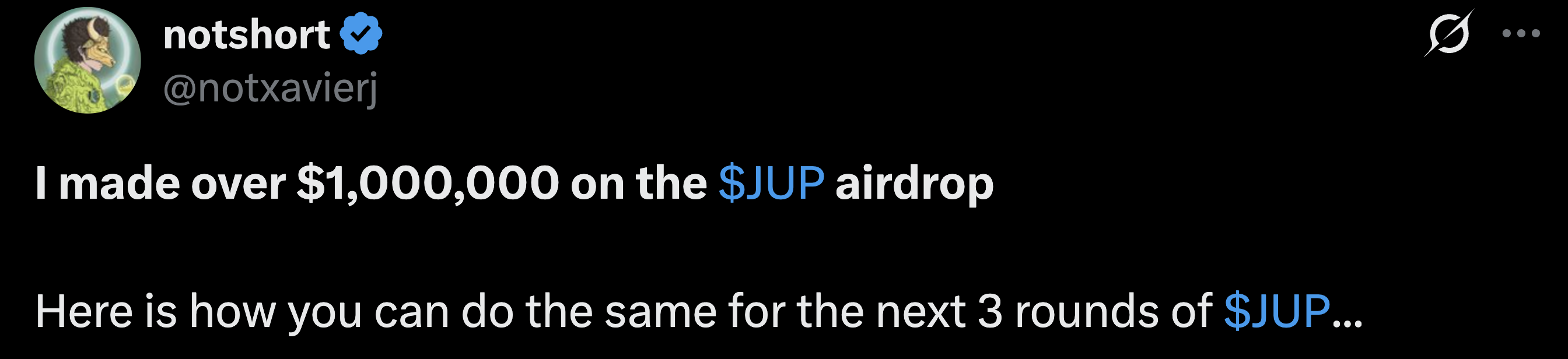
I saw lots of active Jupiter users on X and Discord receive insane paydays from it, many in the 6 figures, all just from swapping tokens which they were doing anyway. One person even made $1m from farming the airdrop! I however only received a mere 200 $JUP worth just over $100.
Researching the farm
While I didn't make much from the airdrop, seeing other people making life changing money just from swapping coins and talks from the Jupiter team about subsequent $JUP airdrops made me look into possibilities to take advantage of this. I started researching the specifics of the airdrop, going through their Discord and looking on X to find as many details as I could. Thankfully, quite a lot of the important info was publicly available. The 2024 $JUP airdrop was distributed in tiers displayed in the image below. Some other information I found was about their filters to disqualify/punish bots, these were wallets that: have over 25% failure rate (as that would imply some kind of bot like arbitrage bot or something along those lines), have cluster behaviour (wallet appears in a cluster of linked wallets which have qualified for the airdrop which implies a large scale farming setup), stable to stable or same mint to same mint swaps (as these are just junk volume, either people doing arbitrage or farming junk volume).
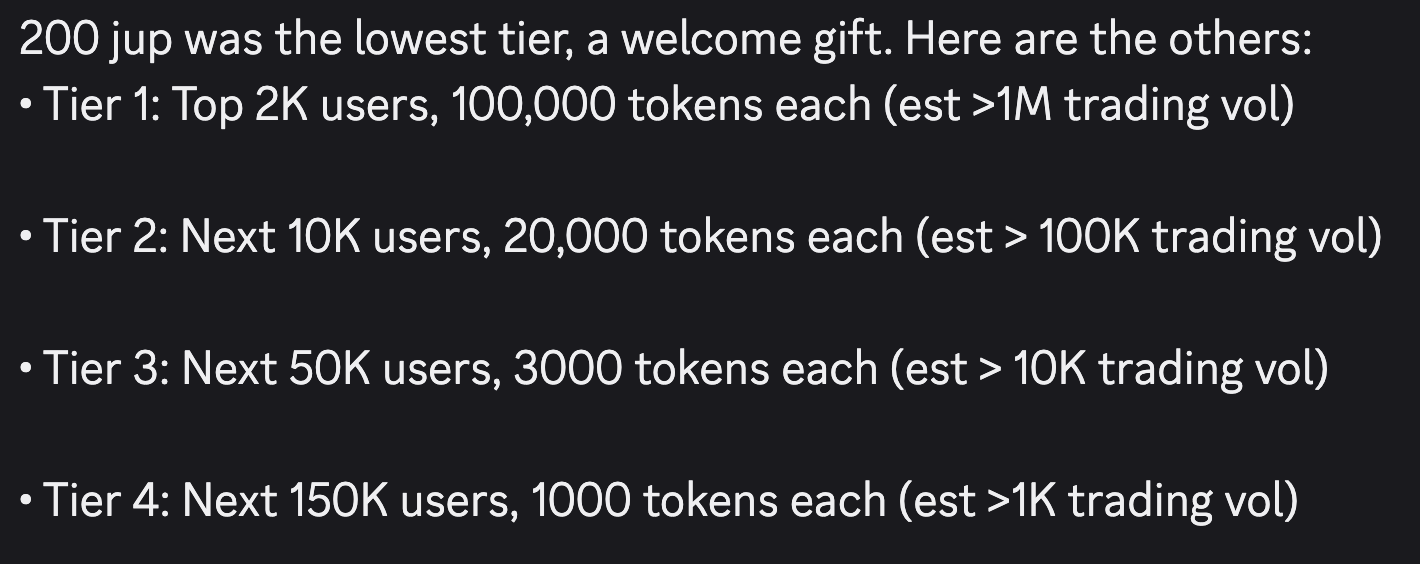
Looking at the distribution tiers and knowing there would be subsequent airdrops each year, I saw massive potential. Assuming the price of $JUP stayed around its current price at the time ($0.6 at launch but going down to $0.5 shortly after), each tier 1-4 would earn you respectively $50k, $10k, $1.5k, $500 and then the $100 for the 200 $JUP bonus tier. Normally when you're using Jupiter for regular use, you aren't working out the cost of swapping or sending the transaction but for mass farming, you would have to work these things out. While Jupiter had no swap fees at this point in time, there are 3 things to consider for the cost of farming:
- Solana transaction fees – The most obvious cost, every transaction you send on Solana requires a fee to process it. The amount of the fee depends on the number of signatures for the transaction you are sending + an optional priority fee to get your transaction processed quicker. Generally, for a Jupiter transaction, base fee is 0.000005000 SOL ($0.000429 (all SOL prices in these sections are prices at the time of when I am writing about) and setting auto for priority fee using the Jupiter swap API in my experience maxed out at 0.0001 SOL ($0.008596) (you can set a manual cap on the priority fee as well) so a total of 0.000105 SOL ($0.009025) for the max fee per transaction. After completing all the farming, the average fee per transaction worked out at 0.000070761 SOL ($0.0060816).
- Cost of swapping – This is made up of a few parts which I have broken down in the sections below. Which when combined together will be around 0.05-0.2% of each trade.
- Price Impact – Simply put, its your trade moving the market. The factor that contributes to this the most is the trade size in relation to the size of the liquidity pool (LP). If you make a large trade in an LP that has low liquidity, you will get a very high price impact. A trade between SOL and USDC for $150 could get you <0.01% price impact since LPs for that token pair will have super high liquidity. A trade between USDC and wBTC could get you 0.1% price impact as the liquidity in the pool is lower. If you're not picking tokens pairs that are super illiquid then you won't get high price impacts but over many trades they can add up. This is a very simple explanation so if you want a better explanation, ask your favourite LLM about the price impact in AMMs on Solana.
- Liquidity Pool (LP) fees – To swap your tokens in an LP, there will be fees to use the LPs. They are generally about 0.01 – 0.05% of the volume going through them. You can get multiple LP fees as the route thats taken for the trade might go through multiple LPs.
- The cost of holding coins – While this isn't necessarily a cost on the swap itself, its part of the farming process. If i hold token x between swaps and token x goes down by 10% during that period then thats 10% lost. This can be mitigated by holding stable coins or just coins that have more stability. This can work in your favour if a coin your holding between swaps goes up in value.
Now working these out, lets say your aiming for tier 2 of the airdrop which give you 20k $JUP worth $10k on launch (I will explain why I picked this tier later), you will need to get to at least $100k volume. Lets say you are farming with $150 each trade, to get to $100k volume, you would need to do 666 swaps. To allow some room for error, we will go with 750 swaps. 750 x 0.000105 SOL (max fee just for worst case scenario) = 0.07875 SOL which is equal to $6.77, this is extremely cheap for the number of transactions, especially when compared to blockchains like Ethereum.
For the cost of swapping, we will take a value of 0.1% for the LP fee and 0.02% for the price impact which combined is 0.12%, these numbers are on the higher end but it allows room for error. Since this is a fixed fee on the volume, we can calculate it as $110,000 x 0.0012 = $132 for the total cost of swapping (I have made it $110k to allow for errors). Although its just a flat fee we have measured, this 0.12% we have calculated with depends on your trade size, if you did a single transaction of $110k, unless you're on a very highly liquid token pair, you will very likely get higher than 0.12% on the cost of the swap but, if you do it over a larger amount like 750 swaps and allow time for the market to react between swaps, you will be able to keep a low % cost of swapping. Doing the volume split between a larger amount of swaps is also helpful for people with less capital as not everyone has $110k to use in a single swap. Another thing to bear in mind is that if you are doing swaps of $150, you will need an extra $132 in your wallet to be able to complete the volume in 750 swaps as if you only have $150 in your wallet, as time passes, your wallet balance will slowly go down so you will no longer be able to complete $150 trades so you will either have to complete the volume in a much larger amount of swaps, or just fund the wallet with more money to allow for this.
Now both of these together (I am not including the cost of holding coins as its not really possible to calculate in advance, and its not an asymmetric change), assuming the same volume goal, trade size and trade quantity as earlier, $6.77 in the transaction fees + $132 from cost of swapping ≈ $139 for achieving the tier 2 airdrop while allowing for errors. $139 cost for a $10k airdrop, this is a massive ROI. The lower volume tiers have even better ROI as the volume:airdrop ratio is even lower.
One thing that could pose a risk to the airdrop which I kept tabs on via Dune was the increase in Jupiter users which would dilute the airdrop amount across many more people. It was quite clear that crypto was on the way up so activity was bound to go up but the Jupiter DEX was also becoming massively more mainstream compared to beforehand when Raydium was very popular which meant that not only would the the number of crypto users in general be going up but so would Jupiter users. The couple months between the airdrop volume cutoff in November to the airdrop in January, you could already see a big increase in Jupiter users so I assumed that trend would continue which it did. With more volume and users on Solana/Jupiter, I assumed that the $JUP price would also go up (which it did) but I believed that it wouldn't go high enough that it would make up for the airdrop dilution from new users. So I did my calculations but assumed in worst case scenario that the airdrop would be 1/10th the size and it was still profitable so I carried on but I kept an eye on the user count throughout the following year.
Planning the farm
As soon as the airdrop happened and I did my research into it, I got to planning out how I would execute. I decided on aiming for $120-130k volume on 100 wallets to try to get a $100k total airdrop. I chose to go for just over $100k volume for a few reasons combined:
- Its a decent level of reward:volume ratio, not too much volume but its reachable
- Farming to $1-10k doesn't take much time at all, having to farm 10 $10k wallets is a lot more to manage than 1 $100k wallet and for 100 $1k wallets, thats even more.
- To farm more human like, I would want to space out the swaps rather than have them all grouped up in one short period, so, if i wanted to farm to $10k, I would hit there pretty quickly and I thought it would be less "human" like behaviour.
- If the airdrop gets diluted massively, you are still getting a good amount per wallet.
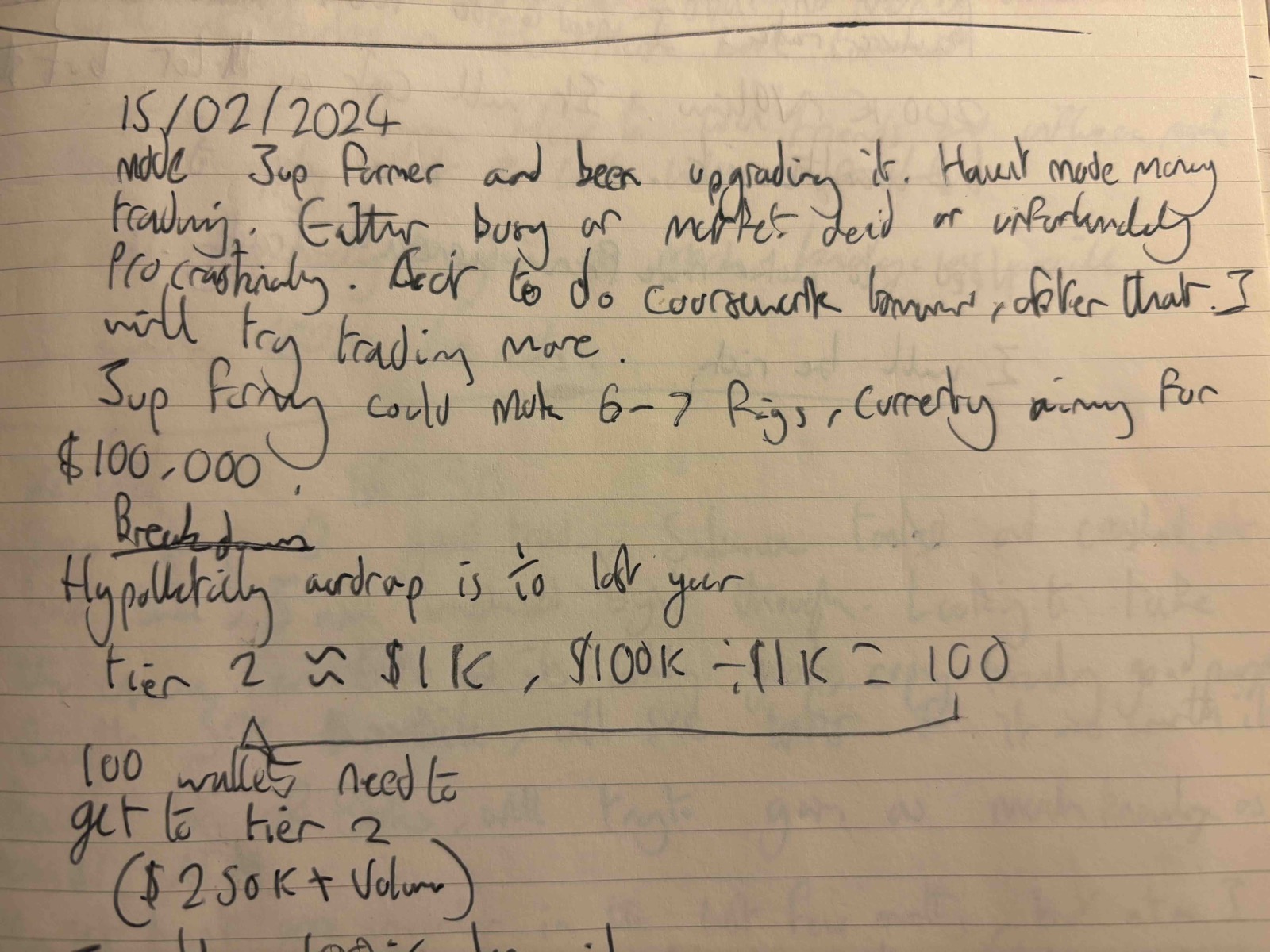
For the method of farming, I knew I would have to make software for it. Farming at a mass scale is possible manually but its messy and time consuming. Developing software based around Solana is very well supported on Rust and JS but at the time I had no experience with rust and very limited experience with JS. If i wanted to develop this software quickly, none of these were viable options. If LLMs were as good as they are now back then, I would've just gone with JS but unfortunately they weren't. Python was the language I was most well versed in but Python support for Solana was not at the level of the other languages. Luckily there were two packages Solana.py and Solders which would do the job.
My original plan for the software was to have a CLI which I would host on a server which would take a crypto wallet and just swap back and forth between 2 tokens on repeat with a fixed time between each swap. You would be able to run multiple of these at the same time to farm more than one wallet at once. I also wanted to have it setup with discord webhooks so you could see what the bot is doing from Discord. The software would develop massively over time but this was just the original sort of idea.
From the research I did, I saw that Jupiter was filtering out bot volume. I was concerned about the chance that I would get my wallets filtered out from the airdrop for bot behaviour so I had lots of plans/measures in place to prevent against this. Many of them turned out to be useless but with a large scale farming operation with lot of time and money on the line, I wasn't taking any chances.:
- I would need to keep the wallets isolated from each other and any other active wallets in the case I got them flagged for being a farming cluster. If you had lots of wallets quite tied to each other that were all farming the Jupiter airdrop and nothing else, it would be easy to single these out and filter them. Keeping your wallets separated was also a reason for me to go for a higher tier farming solution as if they wouldn't filter wallet clusters, I probably would've made something to automatically farm $10k volume then distribute funds to new wallet automatically and repeat the cycle. There could've been ways to use exchanges or mixers to do this but I didn't bother at the time.
- When you send want to send a Jupiter swap transaction, while you send the transaction to a random RPC node that can't track your IP, beforehand, you can request the transaction ready to sign from Jupiter's API which my software did and then Jupiter would have your IP. If I was farming 100 wallets on the same IP and Jupiter was receiving instruction requests from that single IP, I thought it could potentially lead to them filtering all my wallets. To prevent against this, I used proxies when sending requests to the Jupiter API, this turned out to be useless as they didn't take it as a filtering measure but with my experience in sneaker botting and the high stakes, for such an easy solution, it wasn't worth the risk.
- Trade on more stable pairs to keep a low failure rate. Jupiter were filtering wallets with high transaction failure rates so I needed to make sure to keep mine down. This became more of an issue a few months after launch as Solana had some congestion issues which I will go into as I get there chronologically.
- Humans don't do 1000 transactions per day, to maintain human like behaviour, I spaced out my swaps and aimed to complete wallets volumes in the span of months rather than days. Humans also don't trade with 10 mins between each swap each time, I made it so the time between swaps was fairly random to make it appear more human. I added more advanced features to this as well which I will talk about later.
- Swapping the exact same amount of crypto each transaction is not natural, I would have it randomise the crypto swapped to prevent it looking suspicious. Like the other measures, I also advanced this which I will divulge later.
These are the main things I thought about when planning the initial version which as I said, I would develop and advance each part to make them more and more advanced as time passed.
Building the farm
I started coding the day after the airdrop took place, I knew that the airdrop volume qualification for the next airdrop would end in November so while I had a lot of time, I wanted to get farming as soon as possible to maximise my potential gains. While I had experience with Python, I had never done any development related to crypto/Solana so I had a lot to learn about it.
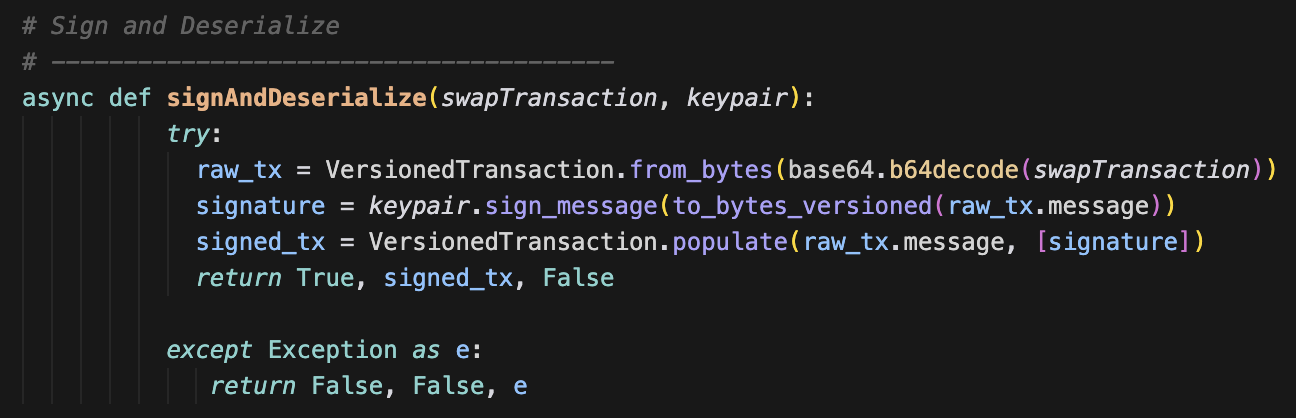
I remember having issues in the development process with trying to sign the transaction that you would receive from the Jupiter API. The swap process would start with you requesting a quote from the Jupiter API, then if happy, you would send that quote back when requesting the serialised transaction to get the actual serialised transaction (just the transaction in raw bytes). In a JS application of this software, you would just need to serialise the transaction ( take it from bytes to the actual transaction object), sign it and then send but due to limitations with signing versioned transactions in Solders, that wasn't possible. I was stuck for a while working out how to do this but eventually ended up on the process of receiving the serialised transaction from Jupiter, deserialising it, getting the message of the transaction, serialising that, signing it, building up the versionised transaction again with the signature and then sending it.
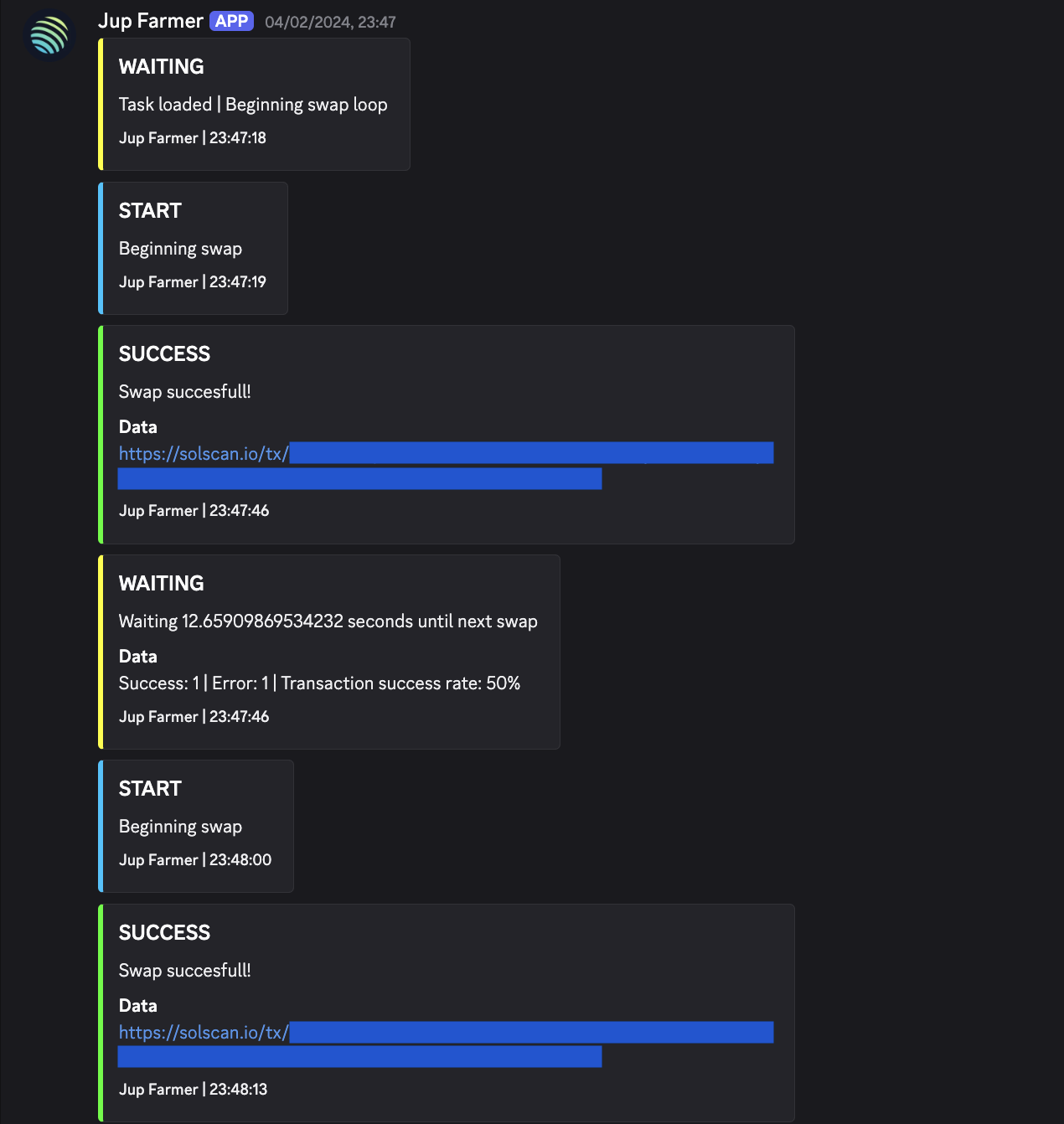
The earliest successful transactions I can see on Solscan from my automated farming wallets is on 2nd February, just 2 days after the airdrop, but these were just single swaps for getting the code for swapping to work as to begin with, I just got the code for the Solana interactions complete before writing the rest of it. It was on the 4th February that the first discord webhook for the software came through, just a placeholder embed followed by a bunch of errors while i was trying to get the code to work. Then on 10pm that day when I had the first successful swap sent to discord from the actual whole program rather than just a debug version. Then just before midnight same day, I finally had the farming loop successfully setup. Was far from perfect but I got the very first initial version working a few days after the airdrop.
Running the farm
The next day, after a few improvements, I got it automatically farming on 2 wallets, the day after even more and by the end of the month I had 10 wallets automatically farming with over $300k in volume across the wallets. It wasn't much but it was a start. Near the end of the month, I also started onboarding friends onto the farming, I explained to them the concept along with all of the risks involved and got them setup.
I remember around this time starting to focus on more circumventing potential bot prevention measures. I had each wallet only farm at particular times of the day to make it seem more human like as no human is swapping 24 hours per day, I also made the timings between swaps more realistic and spaced out and also made the tokens swapped much more varied so it wasn't just swapping from Sol to USDC back and forth. Most of these measures I took were overkill in the end however with such big uncertainty to how strict they were going to be with filtering bots, since the downside for adding and implementing these measures was small, they were worth adding.
Scaling up the volume and number of wallets being farmed also gave me many more opportunities to find and eliminate bugs or quirks. Other improvements were measures to make sure wallets never ran out of Sol for fees, actually adding volume and transaction tracking (as the program was so scrappy to begin with that I didn't even add these) and other small issues that I came across.
In March/April of that year, Solana started having serious congestion issues caused by mining programs, increased popularity and general transaction spam. This lead to normal transactions either getting dropped due to validators not being able to process them or for them to outright fail. This was a big issue for my farming for two reasons:
- Transactions getting dropped meant i can't farm. No transactions are actually getting through and no swaps are being made meaning no volume being farmed
- Transactions that do go through but fail lead to higher overall transaction failure rates which were one of the disqualifies for the Jupiter Airdrop
While I couldn't fix the underlying issue with Solana, I could put some countermeasures in place. I raised the priority fee on transactions to have them execute quicker which gave them a higher likelihood of not getting dropped to begin with and higher likelihood of not reaching the parameters for them to fail (slippage or timeout etc). I also just terminated the farming if after 20 transactions, the failure rate was above the accepted rate for the previous Jupiter airdrop (25% failure rate).
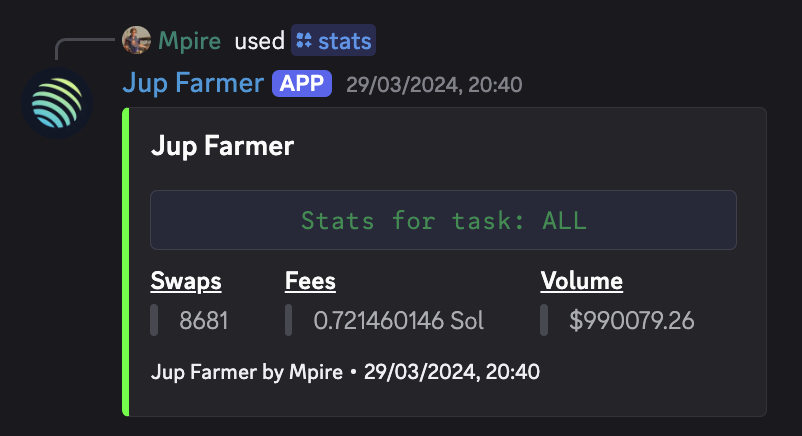
These issues with Solana eventually got fixed and I was able to farm normally like before. By the end of March I was at about $1m volume total across 17 wallets and my main focus was slowly pacing out the volume across all the time i had.
Expanding the farm
While operating the Jupiter Farming project, I was keeping up with all the other potential airdrops on the Solana blockchain, one of which caught my eye. DeBridge is crypto bridging platform allowing users to swap tokens across different blockchains. It was highly speculated and teased that they would do an airdrop fairly soon so I started farming the airdrop manually at a small scale.
In late March/early April, it became increasingly obvious that they were going to start a points system or execute an airdrop fairly soon so I started looking into ways to automate the farming of the airdrop. After a small bit of looking, I found that the API they had was pretty intuitive and simple to apply so I started work on a deBridge version of the Jup Farmer I already made.
Since there hadn't been a deBridge airdrop in the past to reference for profit/airdrop amount estimations, I had to go off instinct and general sentiment in the X airdrop communities. Many people believed it to have good potential so I decided to take the gamble.
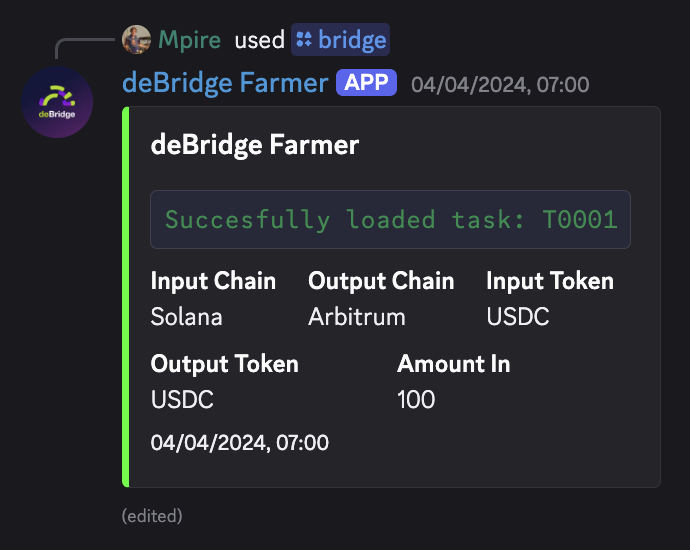
Since the core concepts were the same between the Jup and deBridge farming, I was able to fork a version of the Jup Farmer and start with that. It made the development process a lot quicker and I mainly just had to focus on the Ethereum/L2 integrations. Similar to the beginning of Jup farmer, I had issues getting everything EVM related setup as I had no experience in it nor knew how it worked. On the 9th of April, deBridge came out with their points system publicly which added to the conviction I had in the farming potential.
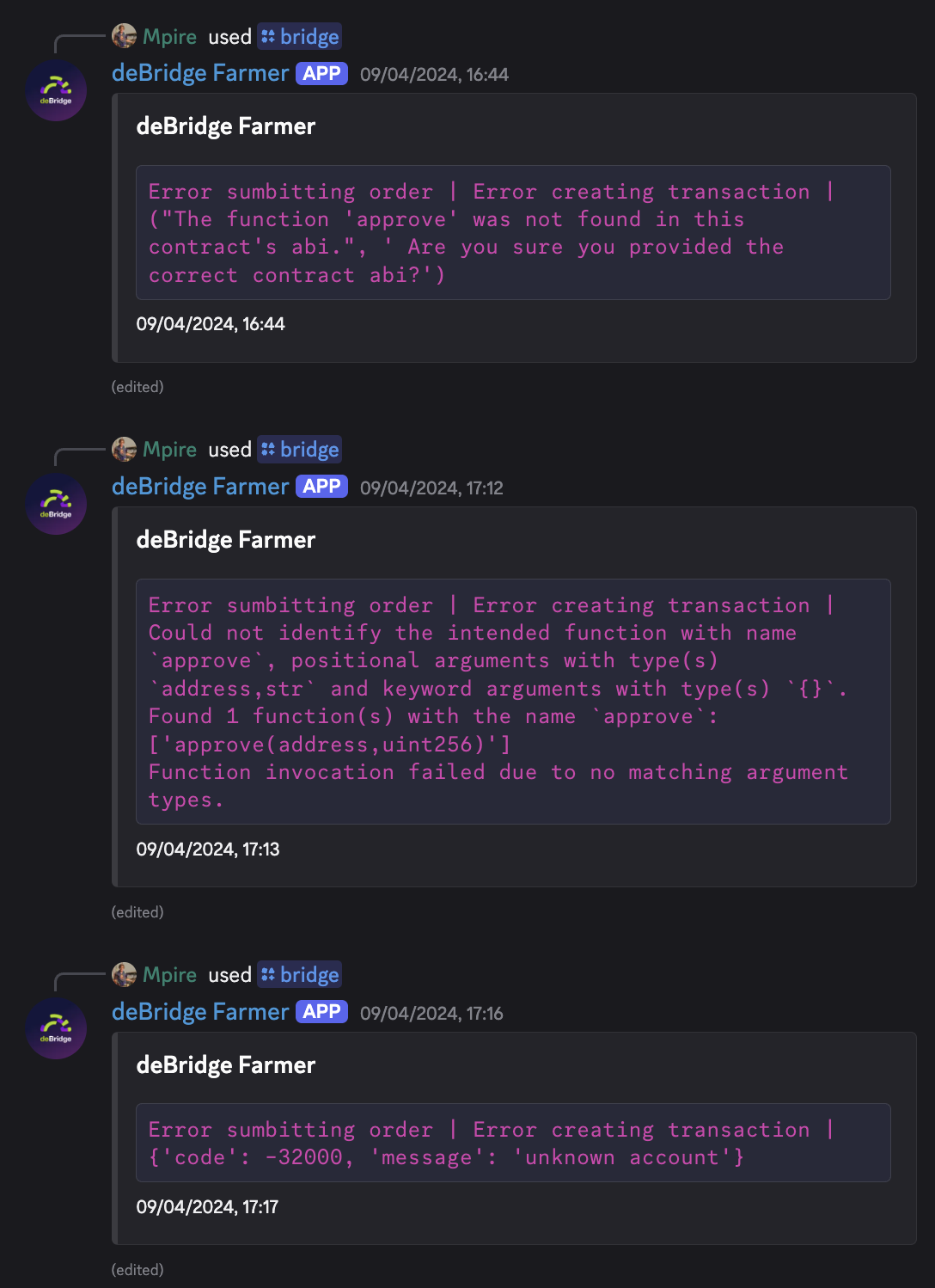
After getting some help from an Ethereum Python Discord group, I managed to get the first transactions going through and from there it was smooth sailing.
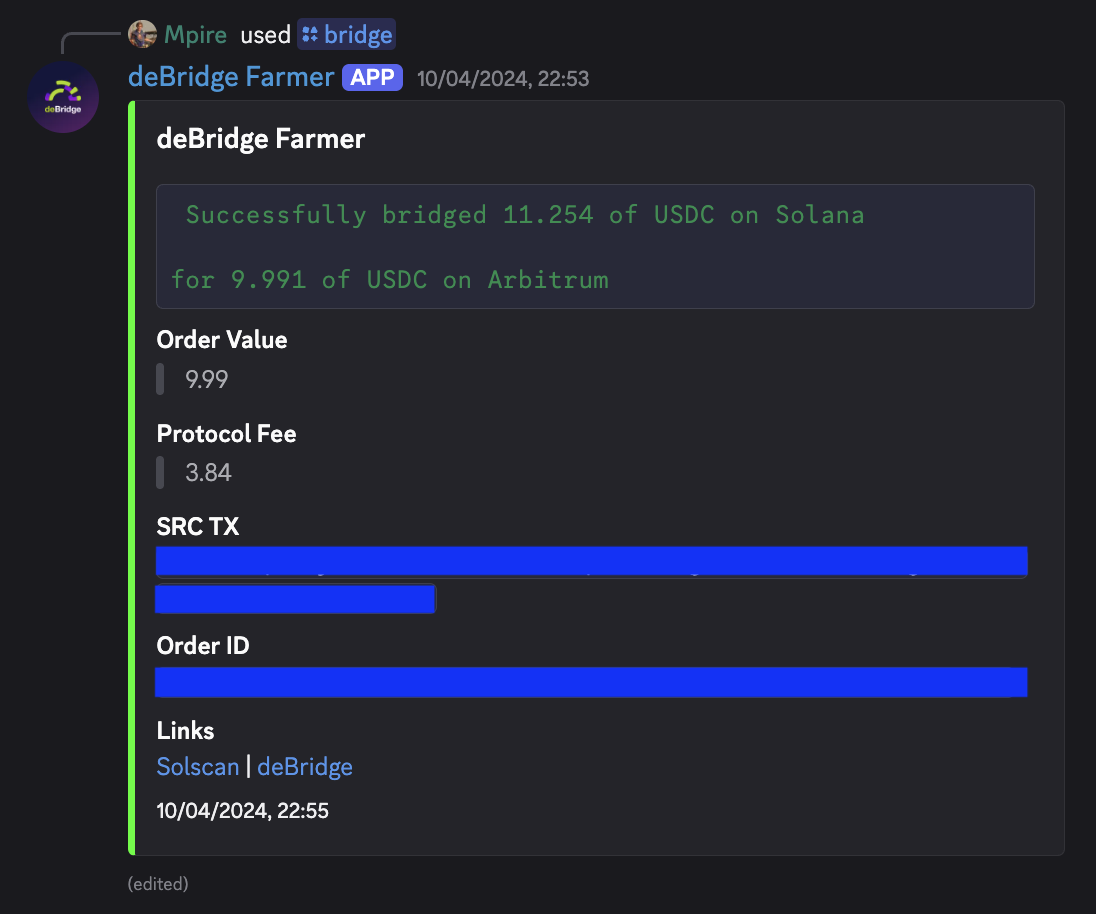
I didn't end up having the deBridge farmer automatically trade like I did with the Jup Farmer, this was because I was farming both airdrops on both wallets and syncing up Jup trades with deBridge trades just complicates the whole process. My deBridge trades were also generally higher value and less frequent. The fees on deBridge are also significantly higher than Jupiter so I wanted more control over it.
Reaping of the sow
From here, I just had both farms do their thing and generate me volume. Over time I increased the wallets for both farms and was slowly reaching the volume goals for my wallets. I ended up not farming as many as I originally planned to, this was a mistake on my part, I was preoccupied with other things in crypto and had a lot of my money in other things when i should've had it farming with the bot.
On the 23rd July 2024, deBridge took the snapshot for the first airdrop meaning all farming from then onwards wouldn't go towards the airdrop qualification so I stopped from then onwards. The token launched on the 17th October 2024, I didn't farm the deBridge airdrop massively as it was quite fee intensive but I was able to make a few thousand dollars profit. Not a massive airdrop airdrop I was hoping for but getting it setup was quite easy and was low effort so I couldn't complain. To prevent getting penalised on my airdrop amount, I had to claim half initially and wait until April 17th 2025 for the other half.
I ended up getting pretty much all my Jup farmer wallets up to $100k volume even if the total number of wallets was much less than I originally planned. By October, I had stopped all Jupiter farming as the November volume cutoff was near and we were awaiting more details from Jupiter about the upcoming Airdrop.
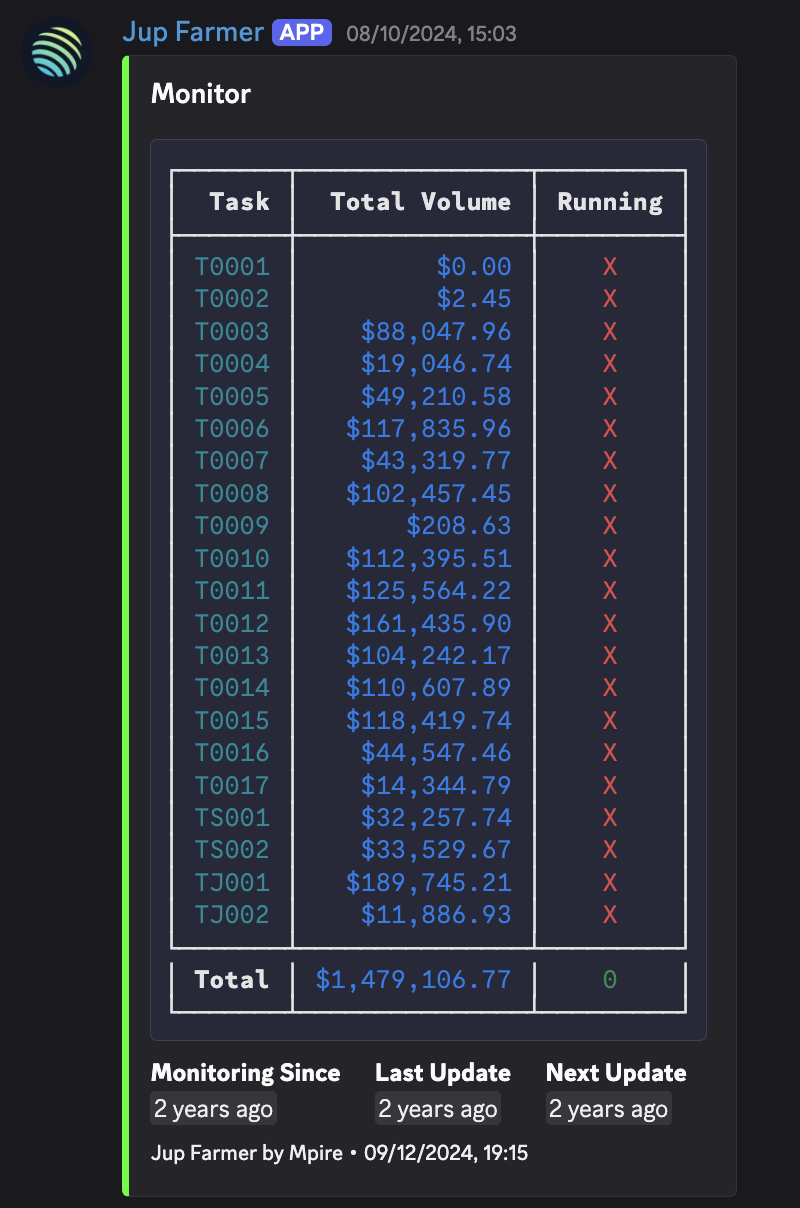
Mid January, Jupiter released the airdrop checker, my airdrop was smaller than anticipated, lots of my wallets which I had tracked at over $100k volume received the tier lower which netted 5x less the rewards while I did 10x the volume. Unfortunately lots of my wallets were hit by this but I will get into my thoughts in the reflection.
Claims went live for the airdrop on 22nd January 2025 however, I believed there would be a dump in the price of $JUP shortly after everyone received their airdrop so I was going to wait for a few days for the price to rise again before selling which I eventually did. I sold all my airdropped $JUP on the 28th and 29th for a more favourable price than on the 22nd and I netted about $10k profit all in all from the airdrop.
I mentioned earlier that I onboarded a friend onto the farm that had no idea about how it all worked but I managed to get him over $1k profit with a $100 investment all passively for him. Nice bonus.
Reflection
In the coming months after the Jupiter Airdrop and the second deBridge airdrop claim, crypto was on its way down, loads of money had been extracted in the prior few years and the market didn't look to be in a good state. $JUP and $DBR were tanking hard and at their prices, it was seeming less and less worth trying to farm the next airdrops. Both platforms were also a lot more popular then than they were when I originally started farming them. I did start work on an improvement to the Jup Farmer shortly after the January airdrop but I gave up on it shortly after as my priorities were shifting back to e-commerce again. Also during the time I was farming these two platforms, I had success farming other more lowkey airdrops which rewarded me exponentially more for much less capital and time investment. I decided to not farm their future airdrops.
Farming both airdrops was definitely worth it, I made low 5 figure profit with a relatively low capital and time investments in both cases while also learning a lot about software integrations with cryptocurrency trading and also evaluating risks and opportunities to make money.
What would I have done differently if I could re-do it? Primarily, I would stick to my original plan. The original plan was to farm 100 wallets to $100k volume. The airdrop for $100k volume was 1k $JUP which around the time of the airdrop was worth around $1k meaning 100 wallets x $1k airdrop = $100k airdrop with maybe $5k spent on fees/swaps/running it. That is exactly my original estimate from when I was first planning the airdrop a whole year before the second airdrop happened. Also, as I mentioned in the earlier section, a lot of the wallets I farmed to $100k volume were classified as only $10k volume which resulted in a much smaller airdrop than I should've got. I believe this happened because some of the volume I did was disqualified for some reason by Jupiter. What I should've done was farm each wallet to $200k instead (which i also said in my original plan, really should've just stuck to that) which would've given room for some volume to be disqualified while keeping me in the $100k+ range. This mistake costed me probably close to $10k. Also, an idea I was thinking about was farming wallets to much smaller amounts, maybe $1k (but get to $2k for safety) and then as soon as its done, have the bot automaticly create a new wallet, send the funds there and swap farm on there, then once done, send to a new wallet and just rinse and repeat that. I didn't go for that approach initially because it would look like a very clear web of farming wallets and would 100% qualify me as sybil but now looking back, there are ways I could've gotten around it. The volume:airdrop reward ratio for smaller volumes are much better than the higher ones so it was definately a potential approach.
I probably would've tried to get a service/saas where I would sell the software/service to other people and they would pay x amount in a monthly fee or a small % of their volume and it would farm the airdrop for them. Charging nothing and then taking a percentage of their eventual airdrop would be nice but in crypto, you get a lot of people that would make the money with the software then run away never to be seen again so I don't think that would've worked out. But charging users as they farm could've definitely worked out.
Overall these airdrops weren't my best in terms of the reward I received from them but I learnt a lot from them and I got enjoyment from making the software itself and helping friends make money with it as well.
This post was written years after the events took place so I might not be 100% right on the dates/timings but its to the highest accuracy I could. Also, I believe the Jupiter API has changed since I made the software so it is likely outdated and might not work.
Github links:
- JupFarmer – https://github.com/Mpire25/jup-farmer
- deBridge – https://github.com/Mpire25/deBridge-farmer
(I haven't used the software since using them back in 2024 so I don't believe they work anymore.)